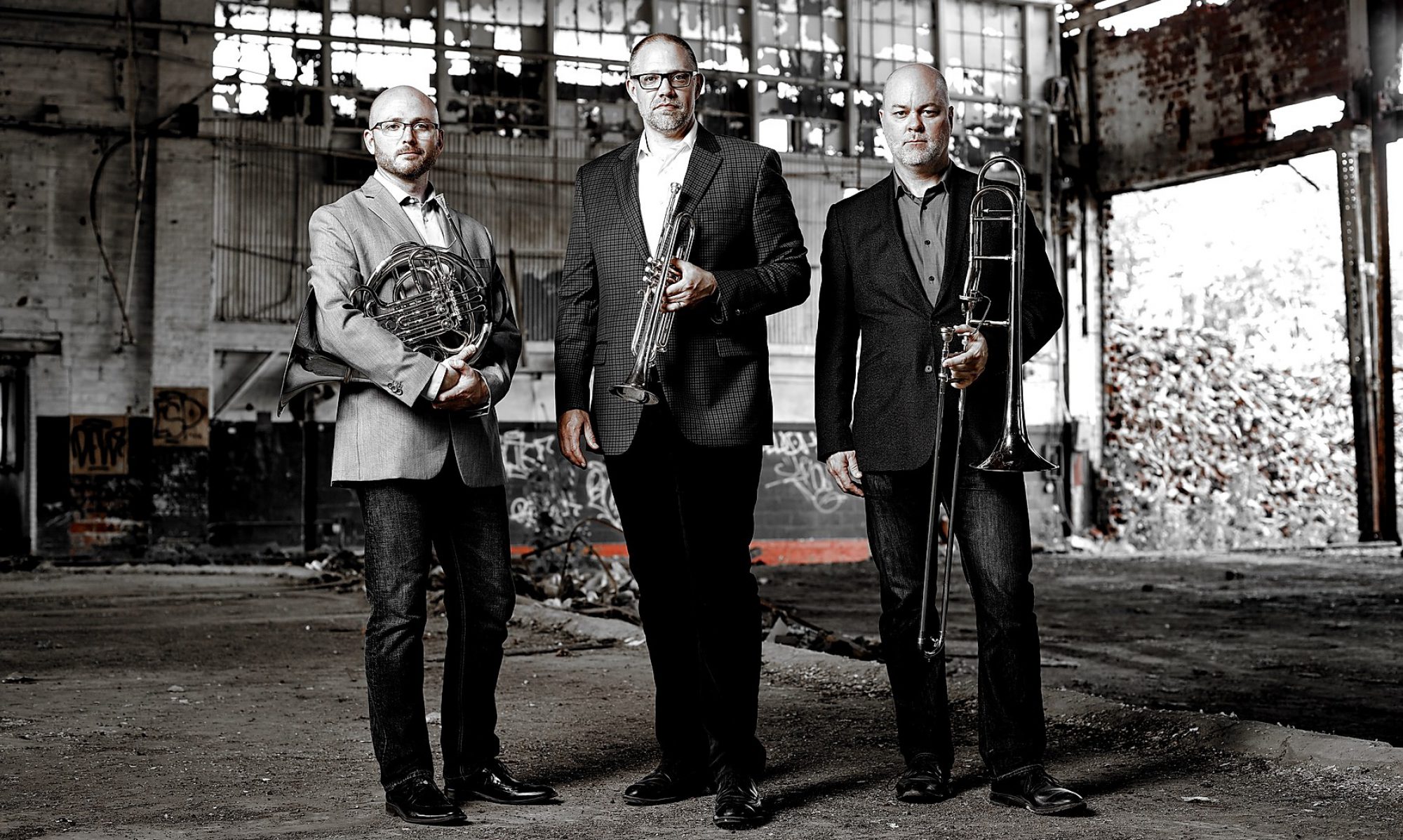

Peaks and Valleys features works carefully chosen to display not only the great colors and contrast achievable by this unique ensemble, but also to explore the distinct perspectives of some of America’s great brass composers. Arthur Frackenpohl, Robert Sanders, Robert Marek, Leslie Bassett, Robert Nagel, and Anthony Plog are familiar names in brass chamber music, and all have written captivating and dynamic works for the brass trio, featured on this album. Aptly named, the album is sure to take the listener through the highs and lows of contemporary brass chamber music artistry.
Reflections on the Music:
Arthur Frackenpohl is a name familiar to almost any American brass student, and to many piano students as well. While a professor at SUNY Potsdam, Mr. Frackenpohl wrote many compositions for brass, arranged many other tunes for varying chamber configurations, and compiled an authoritative anthology for piano pedagogy. FSBT had the delight to perform the trio for Mr. Frackenpohl in 2016, on a visit to the Frackenpohls in Rochester. Like the man, the music is humorous and quirky, delightful in its earnestness and lack of pretense. Motives abound in the opening movement and are passed around freely among the players. The Air is one of the most simple and touching pieces of music we think exists in the brass trio repertoire. After a humorous scherzo with shifting meters, Frackenpohl closes his trio with a finale that is one part sweetness and two parts circus polka.
Robert Sanders is probably best known for having served as Dean at the prestigious Indiana University Music School, a school which flourished under his leadership after Sanders became Dean at the young age of 32. When one reads his accomplishments, this audacious appointment does not surprise. Sanders appeared as a piano soloist with the Chicago Symphony as a child, was a conductor and composer, organist and contrapuntist. Like Bassett, he won the coveted Prix du Rome for composition. His trio is in some ways the most traditional presented here. Sanders uses sonata form and motivic unity to create a logical, complete work. Following the dense, tense first movement, the second movement shifts to a compound meter with minimal accompaniment. This compound grouping morphs into a march for the finale that sounds as if it were written by Sousa’s alter ego.
Robert Marek enjoyed a career in music as teacher and composer, serving as Professor of Music Theory at the University of South Dakota for thirty years. His works range from highly challenging pieces for the professional musician to commissioned works suitable for high school and even younger musicians. Though he composed two brass trios in his life, this first trio is the only one which was published (FSBT has obtained the manuscript for the unpublished second trio and hopes to bring that to life). He writes in an identifiably American language, with the mixed meter and open harmonies of the first movement creating a tunefully optimistic yet aurally challenging atmosphere. The poignant Elegy features opportunities for each of the three instruments to have melodic sections while a processional rhythm carries through the entire movement. The ebullience and generally goofy quality of the final movement make this one of FSBT’s favorite mid-century works.
Trombone was the instrument of choice for Leslie Bassett, and it is perhaps his familiarity with the lower spectrum of the brass alloy family that gives his trio the darkest and thickest texture of the works presented here. A veteran of World War II, when he served as trombonist, composer and arranger with the 13th Armored Division Band, Mr. Bassett led a distinguished career as a composer. A student of such luminaries as Nadia Boulanger and Arthur Honegger, his works were performed by major orchestras across the globe, and he taught at the University of Michigan for many years. His Trio opens without means of introduction, dropping the listener at once into a bristling nervous energy. This unsettled sense permeates the first movement, and Bassett ingeniously make the trio sound as if it had more voices by crossing registers and blending timbres. This nervousness takes a different form in the brief second movement, where quick muted themes dart about in search of an answer. His demonstrative finale opens with an angular theme in unison before working over the fragments toward a rousing, rhythmic, and affirming conclusion.
Though through-composed, the trio by Robert Nagel is in two distinct sections. The opening Andante has a ceremonial solemnity in its compound meter theme. Like Marek and certainly Copland before him, Nagel uses wide open intervals that so define the “American” sound – yet here the theme conveys more reflection than optimism. Any sense that this piece could be trending toward the dark is dispelled by the buoyant, sunny allegro that follows. One of the pillars of American trumpet playing, Nagel keeps this first of his two composed brass trios uncomplicated and to the point. As producer Jon Nelson put it, “Bob was the kind of guy who not only brought his lunch pail every day, it had a bologna sandwich in it”. Like the sandwich, with a little mustard the piece is pretty satisfying.
Anthony Plog’s Trio for Brass is a staple of the modern brass trio repertoire. Written in two large sections, the movements within flow seamlessly into each other, using solo cadenzas for each instrument as the connective tissue. From the opening percussive hit of the first movement, the piece alternates between clever rhythmic motives and lyrical expressions. Plog writes for the flugelhorn rather than trumpet, which provides a different range of sound timbre options for the trio. The darker sound of the flugel provides for a group sound more akin to a traditional string trio, in which individual voices are less distinct. An outstanding trumpeter himself, Plog’s familiarity with the instruments is apparent in how he asks each player to explore the nooks and crannies of their technique. By continually changing roles throughout the piece for each player, Plog creates a fascinating sonic landscape of dexterity and at times deception, with an energetic interplay of shifting arpeggios that propels the work to its breathless finish.
Thanks for listening and reading
– FSBT